Meta thought it had cracked the AI-native team. Instead of the usual 10 to 20 person product group, it shrank things down to "pods" of three to five people, leaning hard on AI tools and agents to make up the difference.
The numbers looked great at first glance. Code changes to Meta's internal platforms and infrastructure were up 220% year-on-year. Then you look past that one metric: features that actually reached users rose a much more modest 36%, major technical and security incidents jumped 40%, and time spent firefighting those incidents rose 70%.
It's not just Meta either. DX's research across 500+ organisations found median weekly pull request throughput up 37%, while their Developer Experience Index (a measure of how frictionlessly people can actually do their work) fell from 67 to 65 over the same period. More output, worse experience. As Brian Houck from DX puts it, "we are often falling in love with our output numbers and not paying enough attention to our outcome metrics."
Peter Bell, who's writing an O'Reilly book on scaling AI adoption, reckons the sweet spot is more like five to eight people, even if only one or two are touching the same repo. Part of that is technical, several people plus agents can generate more simultaneous changes than a team can safely review. But part of it is just human: "it's nice to have a group of five to eight humans because that works for humans and it creates a sense of connection."
That number should sound familiar if you've spent any time around agile theory. The 7 ± 2 rule for team size didn't come from nowhere, it's borrowed from Miller's research on working memory, the idea that people can hold roughly seven items in mind at once before things get lossy. Applied to teams, it's really a stand-in for two things: how many relationships someone can track meaningfully, and how fast communication overhead grows. Brooks's Law is the sharp version of that second point, the number of communication paths in a team grows as n(n-1)/2, not in a straight line.
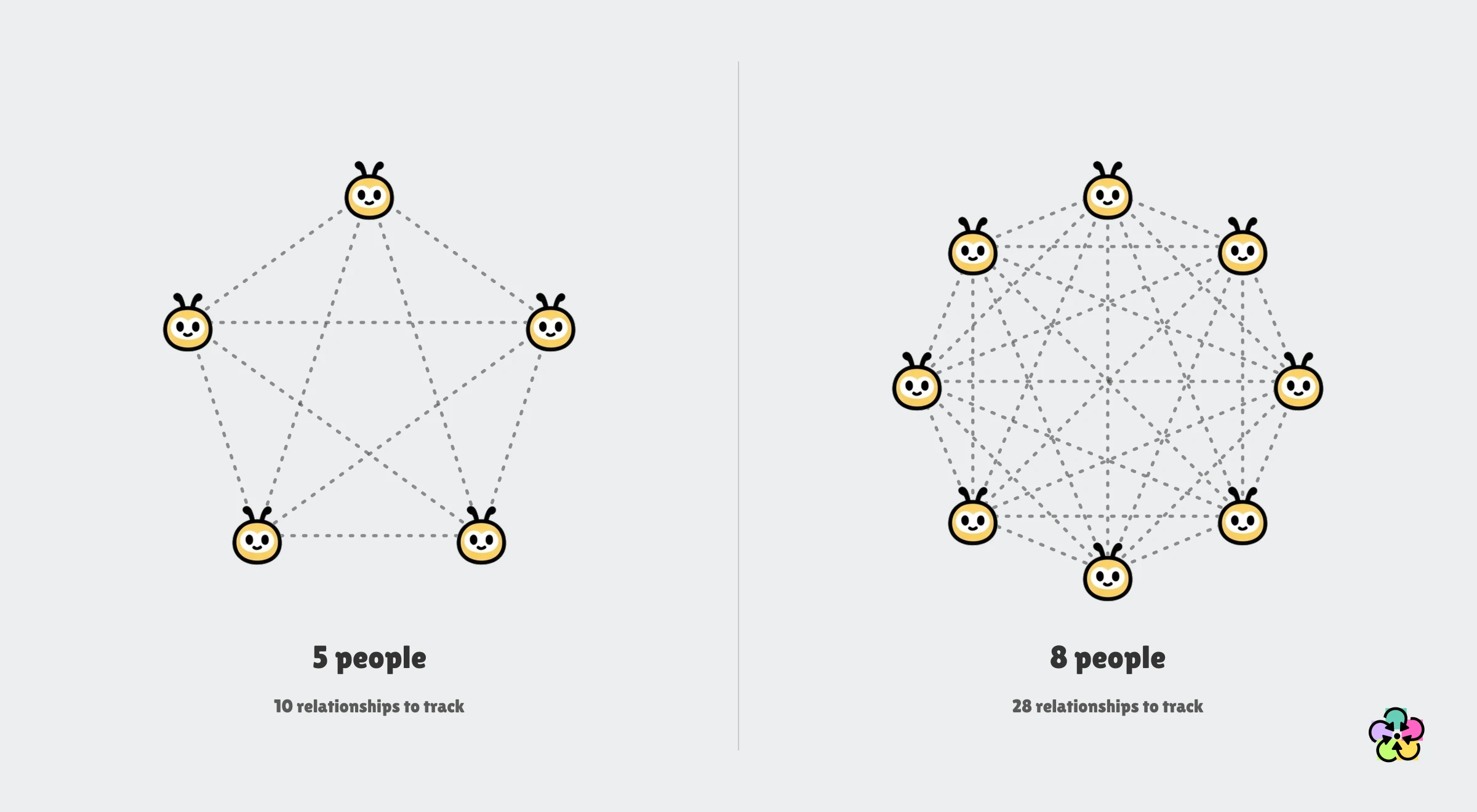
Three extra people doesn't mean three extra relationships to manage, it's 18 more. That's the maths behind why both Bell and agile theory land on roughly the same number, and it's before you even factor in AI multiplying how much each person produces.
Size doesn't just affect output, it affects who speaks
Meta's story is about a team that got too small to safely absorb what AI let it produce. But I've seen the opposite problem plenty of times too, teams that get too big to be psychologically safe.
In a larger group, the more vocal people naturally end up dominating the conversation, and quieter folks learn to hide behind them. Some people who'd normally speak up without a second thought get more hesitant just because the audience is bigger. It's not usually deliberate on anyone's part, it's just what happens to group dynamics once you pass a certain size. More people in the room doesn't mean more voices heard, often it means fewer.
None of that makes large teams bad. Plenty of work genuinely needs more than eight people. It just means size is something to actively manage rather than ignore, especially when you're running a health check like PETALS, or any other check-in that depends on people actually saying how things are going.
A few things worth doing if your team sits outside that 5-9 band:
Split the conversation, not just the work. If a health check happens in one big group, quieter voices get lost in the room dynamics before they ever answer a question. Smaller breakout groups, or individual async responses that get aggregated afterwards, give people room to say what they actually think.
Watch for silence as a signal, not an absence of one. If someone's scores are consistently low, or they're not engaging with a snapshot at all, that's not nothing. It might be exactly the thing a bigger team makes harder to say out loud. Treat it as data worth following up on, not a gap to skip past.
Don't assume confident people stay confident at scale. Someone who speaks up freely in a team of six might go quiet in a team of fifteen. That's not a character trait, it's a response to the room getting bigger. Worth checking in on directly rather than assuming their silence means nothing's changed.
Where this lands for PETALS
Teamwork and Serenity, two of the five petals, are both sensitive to team size in ways that are easy to miss. A team that's too small to safely handle its workload burns out fast, which is exactly what Meta's incident and firefighting numbers show. A team that's too large for people to feel safe speaking up quietly loses the honesty a health check depends on.
The agile 7 ± 2 guidance and Bell's five to eight both point at roughly the same band, and it's not a coincidence. That size is small enough for real communication overhead to stay manageable, and small enough for people to feel like individuals rather than a face in a crowd. Above it, and below it, you're managing a different set of risks. Worth knowing which one you're actually looking at before you decide the team just needs to talk more.
Worth keeping an eye on
It's hard to miss how hard big tech is pushing AI right now, even the personal kind. Buried under the Apple keynote headlines this week, Meta launched Muse, a personal AI agent that can shop, book travel, fill out forms and generally act on your behalf. It's a very different product to the AI pods story above, but it's the same underlying bet: that AI, applied broadly enough, makes things better.
We're not throwing stones here either. PETALS is a small team with limited capacity, and we lean on AI for a good chunk of our own work. Whether that broader push, personal assistants and all, is actually helping teams rather than just producing more stuff, is a bigger question than this post. We'll save that one for another time.
This is the kind of thing our newsletter subscribers hear about first. If you'd rather get product updates and insights like this straight in your inbox instead of waiting for the blog, subscribe below.